Your Credit Score Explained: What It Is, How It Works, and How to Improve It
▶ Watch this as a video ↓
Photo by Sompoch Sivakosit
You open your banking app and see a 740. You feel good about that. Then you apply for a mortgage and the lender comes back with a 690. Now you're confused, maybe a little frustrated, and wondering if someone made a mistake.
Nobody made a mistake. Here is what is actually happening. By the end of this, you will understand what your credit score really is, how it is calculated, how to improve it, and one thing most people have never done that could protect you from identity theft today.
What a credit score actually is
A credit score is a three-digit number between 300 and 850 that tells lenders how risky you are as a borrower. The higher your score, the more a lender trusts you, and that trust translates directly into better interest rates, better loan terms, and access to more loan products.
On a mortgage, a 50-point difference in your score can meaningfully change your interest rate. A better rate compounds over a 30-year loan into thousands of dollars in savings. It is not a small thing.
Why the score in your app is not the score a lender pulls
There is not one credit score. There are two major scoring frameworks, FICO and VantageScore, and each has multiple versions depending on what type of credit you are applying for. The model used for a mortgage is different from the one used for an auto loan or a credit card. Your bank is likely showing you one version of your score. Your mortgage lender pulls a different version.
Until recently, mortgage lenders only used FICO scores. Some lenders have started accepting VantageScore as well, which has helped certain borrowers qualify for better rates. But the core issue remains: the score your app shows you is not necessarily the score that gets pulled when you apply.
The three credit bureaus and why lenders use the middle score
In the US, there are three major credit bureaus: TransUnion, Equifax, and Experian. Any lender you have an open account with (a credit card, car loan, or mortgage) reports your payment history to these bureaus. The bureaus use that information to calculate your score.
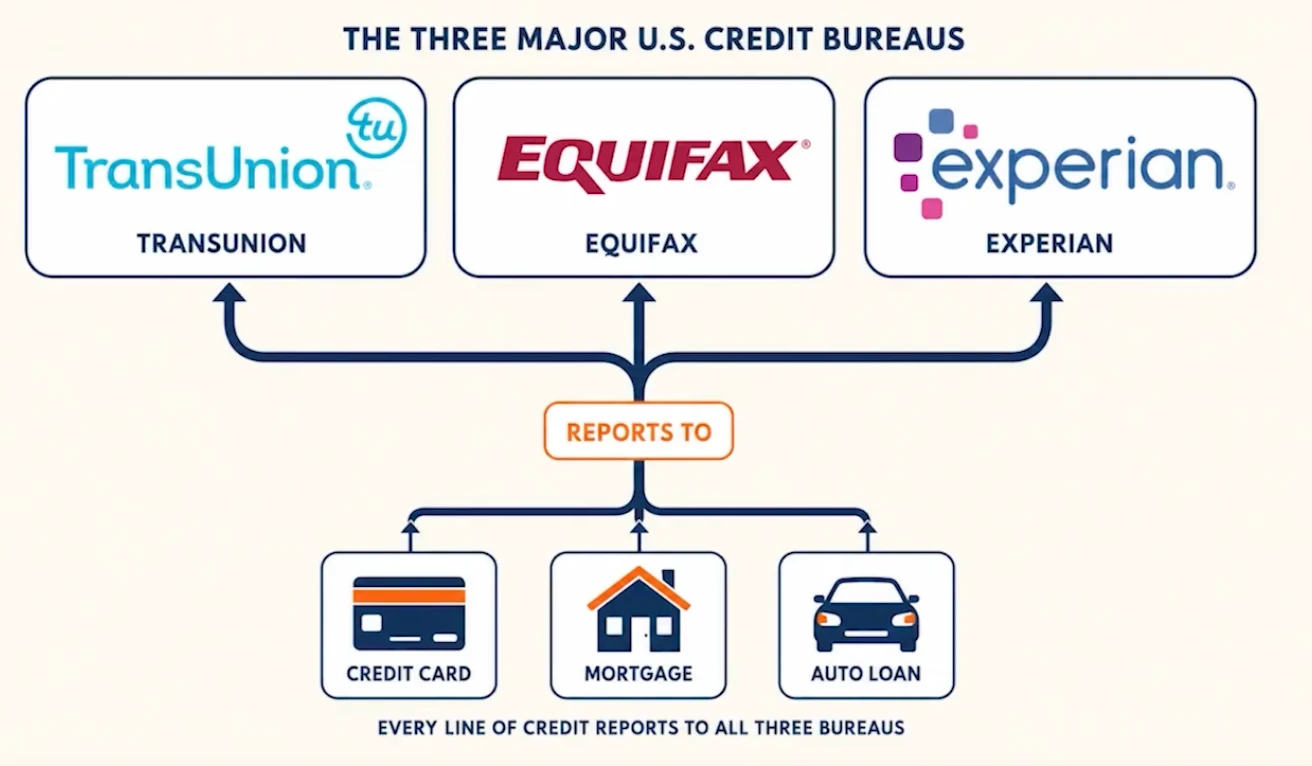
Not every institution reports to all three. So each bureau may have slightly different information on you, which is why they produce slightly different scores.
When you apply for a mortgage, the lender pulls all three scores and uses the median - the middle one. Not the average, not the highest. The middle. So if your scores are 750 at Experian, 730 at TransUnion, and 710 at Equifax, your mortgage score is 730.
Each bureau has a website where you can check your own score and report for free. Checking before you apply for a mortgage is worth doing. The numbers will not match what your lender pulls exactly - different scoring models - but it gives you a much better picture than your banking app alone. More importantly, review each report for errors. Inaccurate information appears more often than you would expect and can drag your score down for something you never did. If you find something wrong, you can open a dispute with that bureau to have it investigated and removed.
How your credit score is calculated
There are some differences across scoring models, but the five major factors are consistent:
Payment history - 35%
The biggest factor. This is whether you pay everything on time - credit cards, car loans, mortgage, everything. A late payment typically stays on your report for seven years. A bankruptcy stays for seven to ten depending on the type. The further in the past a late payment is, the less it affects your score, but a very recent one can drop your score 50 to 100 points.
Credit utilization - 30%
This is how much of your available credit you are actually using. Each month, your lender reports your balance to the bureaus on your statement date. If you have a $10,000 credit limit and your balance is $5,000 on statement day, your utilization is 50%. For a good score, keep it under 30%. For a top-tier score, under 10%.
The key detail here: your lender only reports once a month, on the statement date. If you pay your balance down before that date, the bureaus see a lower number. You do not have to wait for the payment due date - paying early directly improves how your utilization looks.
Length of credit history - 15%
How long your accounts have been open and what the average age of your accounts is. Longer history signals more experience managing credit, which lenders view favorably.
Credit mix - 10%
Lenders want to see that you can handle different types of credit - a car loan, a credit card, a mortgage. Having a mix increases your score slightly. Opening multiple credit cards does not help your mix because it is all the same type of credit.
Recent inquiries - 10%
Every time you apply for new credit, the lender does a hard pull of your credit report. Each hard pull can temporarily knock a few points off your score. One important exception: if you are shopping for a mortgage with multiple lenders and they each pull your credit within a 30-day window, it typically counts as a single inquiry. The scoring models recognize rate shopping and do not penalize you for it. Applying for five credit cards in a month is a different story.
How to improve your score
Pay on time, every time. Payment history is 35% of your score. There is no faster way to hurt your score than a missed payment, and no more reliable way to build it than a clean payment record over time.
Pay down balances before your statement date. If your utilization is high, you do not have to wait until the due date to pay. Pay before the statement date and the bureau sees a lower balance - which means better utilization, which means a higher score.
Keep old accounts open. Closing an old account shortens your average credit age and can hurt your score. Even if you are not using an old card, keeping it open maintains your history.
Dispute errors. Go to the websites for Experian, TransUnion, and Equifax and review your reports. If something is wrong, file a dispute. An error that gets removed can improve your score immediately.
Be patient. If you have a history of late payments, your score will not recover overnight. But late payments affect your score less as time passes, and they eventually fall off the report entirely. Consistent on-time payments and lower utilization will move the number in the right direction - it just takes time.
Credit freezes: the thing most people skip
This is the part of the credit conversation that almost never comes up, and it probably should.
When you apply for a loan, you hand over your name, date of birth, and Social Security number. A lender uses that to pull your credit. If someone else gets hold of that information - through a data breach, a phishing scam, or any other way - they can use it to apply for credit in your name. They get approved, run up a balance, and disappear. You are left dealing with the fallout: police reports, fraud disputes, and a damaged credit report.
A credit freeze prevents this. When a freeze is in place, no lender can pull your credit - even if someone hands over all your correct personal information. The pull simply fails.
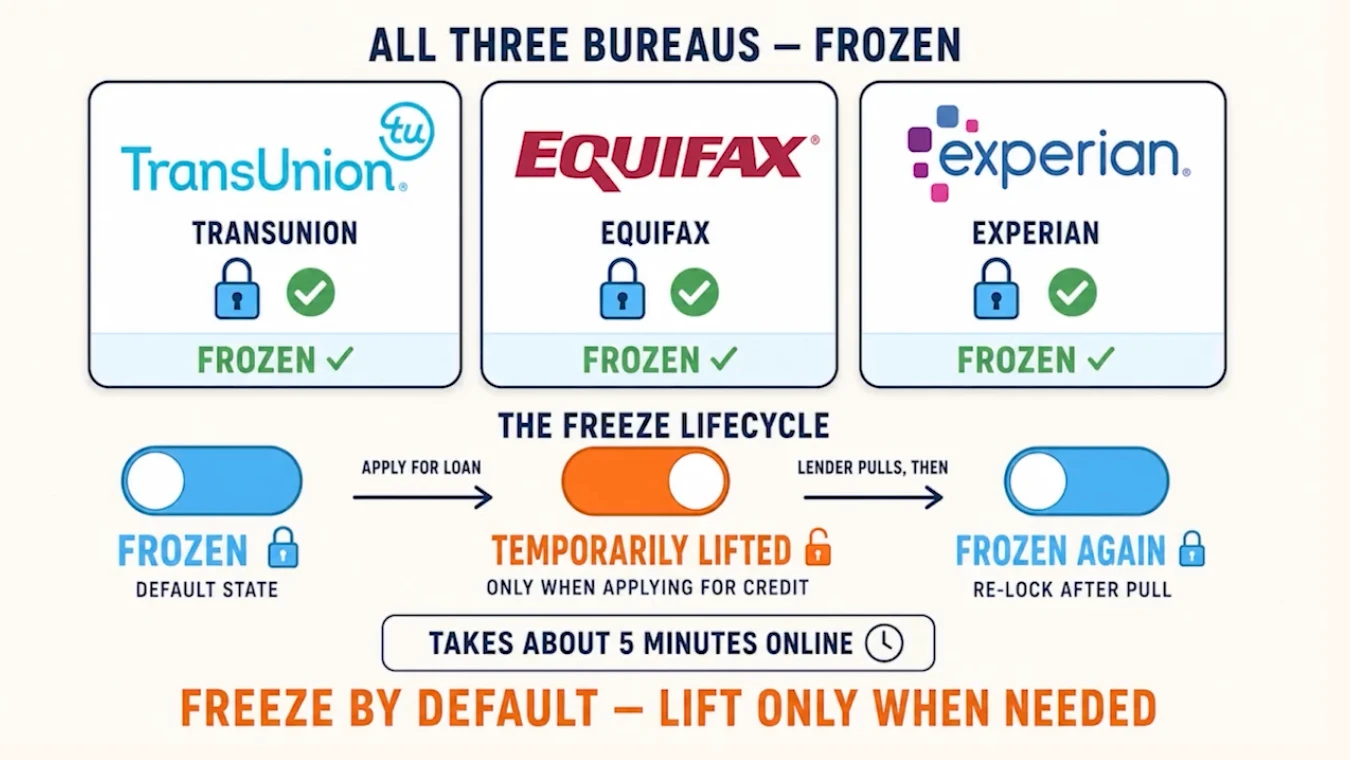
You can place a freeze directly on the websites for all three bureaus. It is free and takes about 10 minutes. When you actually need to apply for credit, you log in and lift the freeze temporarily - that takes about five minutes across all three sites. Once the lender has pulled your credit, you freeze it again.
If you have not done this, it is worth doing today. It costs nothing and adds a real layer of protection.
If you are getting ready to apply for a mortgage and want to understand how your credit score affects your rate and loan options, reach out - I'm happy to walk through it with you.
Watch: Your Credit Score Explained
Still have questions?
Browse the FAQ for quick answers, or get a free, no-commitment quote for your situation.